The building is 27.5 years. But a rental is not only a building: the roof, the new furnace, the carpet, the dishwasher and the driveway each have their own recovery period. This table lists the common rental assets, the period and method the IRS assigns, and how to work out the first year.
Under MACRS, the general depreciation system the IRS uses for rentals, a residential rental building and anything that becomes part of it (roof, HVAC, plumbing, wiring, windows) is 27.5 years. A commercial building and its components are 39 years. Land improvements such as fences, driveways and landscaping are 15 years. Appliances, carpet and furniture used in a residential rental are 5 years.
Land itself never depreciates. Buildings use straight-line with a mid-month convention; personal property and land improvements use declining-balance methods with a half-year convention unless more than 40% of the year's purchases land in the last quarter.
| Asset | GDS recovery period | Method and convention | Notes |
|---|---|---|---|
| The building and its structural components | |||
| Residential rental building (house, condo, duplex, apartment building) | 27.5 years | Straight-line, mid-month | Residential means 80% or more of gross rent comes from dwelling units. |
| Nonresidential building (office, retail, warehouse) | 39 years | Straight-line, mid-month | Applies to mixed-use buildings below the 80% dwelling-unit test. |
| New roof | 27.5 years (39 commercial) | Straight-line, mid-month | A structural component, so it follows the building. |
| Furnace, central air, water heater, ductwork | 27.5 years (39 commercial) | Straight-line, mid-month | Building systems follow the building. |
| Windows, doors, siding, plumbing, electrical | 27.5 years (39 commercial) | Straight-line, mid-month | Includes rewiring and repiping. |
| Kitchen or bathroom remodel (cabinets, counters, tile) | 27.5 years | Straight-line, mid-month | Built-in work is part of the building; freestanding appliances are separate. |
| Interior improvement to a commercial building (qualified improvement property) | 15 years | 150% declining balance, half-year (straight-line if you elect it or use ADS) | Nonresidential only; excludes enlargements, elevators and structural framework. |
| Land improvements | |||
| Fences, sidewalks, driveways, parking areas | 15 years | 150% declining balance, half-year | Land itself is not depreciable. |
| Shrubs and trees next to the building | 15 years | 150% declining balance, half-year | General grading and clearing of land is part of the land. |
| Personal property used in the rental | |||
| Refrigerator, range, dishwasher, washer, dryer | 5 years | 200% declining balance, half-year | Residential rental use. |
| Carpet (tacked, not glued) | 5 years | 200% declining balance, half-year | Glued-down flooring is usually treated as part of the building. |
| Furniture in a furnished rental | 5 years | 200% declining balance, half-year | Office furniture you use to run the business is 7 years. |
| Computer, printer | 5 years | 200% declining balance, half-year | Business use percentage applies. |
| Car or light truck | 5 years | 200% declining balance, half-year | Or skip depreciation and use the standard mileage rate. |
If you elect the alternative depreciation system (ADS), required for some taxpayers who elect out of the business interest limit, residential rental buildings placed in service after 2017 use 30 years (40 years if placed in service before 2018) and nonresidential buildings use 40 years. Most small landlords use GDS.
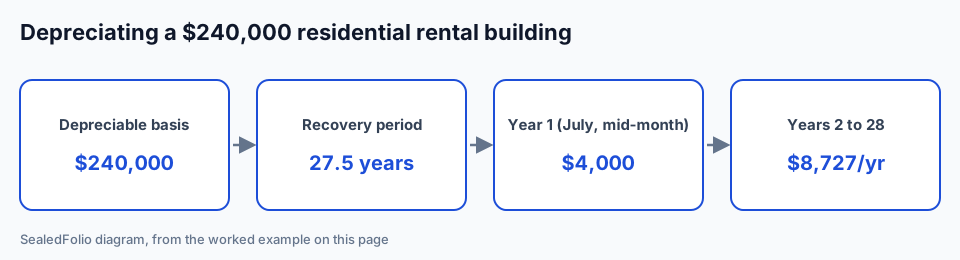
You buy a single-family rental for $300,000 including closing costs you must capitalize. The county assessment splits value 20% land and 80% building, so your depreciable building basis is $240,000. It is ready and listed for rent on July 10.
| Month placed in service | Year-one rate, 27.5-year property | Year-one deduction on $240,000 |
|---|---|---|
| January | 3.485% | $8,364 |
| April | 2.576% | $6,182 |
| July | 1.667% | $4,000 |
| October | 0.758% | $1,818 |
| December | 0.152% | $364 |
Depreciation starts when the property is ready and available for rent, not when the first tenant moves in. If the property sits empty for two months after renovation while you advertise, depreciation has already started.
Assets with a recovery period of 20 years or less, which includes the 5-year and 15-year items above, can qualify for bonus depreciation. The 2025 federal tax law restored 100% bonus depreciation for qualifying property acquired after January 19, 2025, so in many cases the fridge, the carpet and the new fence can be written off in the year they are placed in service. The building and its structural components (27.5 and 39 years) never qualify.
A cost segregation study is an engineering report that splits the purchase price of a building into these classes. It moves value out of the 27.5-year building and into 5-year and 15-year property, so more depreciation lands in the early years. It usually pays off on larger buildings, and the deductions it creates are still subject to the passive activity loss rules.
Whatever you claim is added back when you sell: gain up to the depreciation you took on the building is taxed as unrecaptured section 1250 gain at up to 25%, and on personal property as ordinary income. Our rental property depreciation guide explains recapture.
The trouble with depreciation is not the math, it is remembering. A landlord with three properties and a decade of roofs, furnaces and appliances has dozens of assets, each with its own start date. Lose track and you either miss deductions or overstate them, and the IRS treats depreciation you were entitled to as taken whether you claimed it or not, so it still reduces your basis when you sell.
SealedFolio works out each building's yearly depreciation from its purchase price, land percentage, placed-in-service date and class (27.5-year residential or 39-year commercial), lets you record your own depreciation entries instead when you have a schedule from your preparer or separate assets such as appliances, and carries the year's figure onto Schedule E line 18; Canadian properties use capital cost allowance on the T776 instead. Use the depreciation calculator to check a figure before you record it, and see the 2026 rental property tax deductions guide for everything else that goes on the return. In the first year, SealedFolio counts the month the property was placed in service as a full month, while the IRS mid-month convention counts it as half a month, so the app's first-year figure runs slightly higher than the worked example above. For the first year, check the number against your tax software or enter the exact amount as a depreciation entry.
Depreciation and Schedule E in one local app
SealedFolio Pro is $19 a month or $179 a year for up to 3 properties. Portfolio is $39 a month or $297 a year for unlimited properties. Both come with a 30-day money-back guarantee.
See SealedFolio pricingThis guide explains general federal rules and is not tax advice. Confirm your own asset classes and elections with a tax professional.
A new roof on a residential rental building is a structural component of the building, so it is depreciated over 27.5 years using the straight-line method. On a commercial building it is 39 years.
Carpet that is tacked down rather than glued, and appliances such as a refrigerator, range or washer used in a residential rental, are 5-year property under the IRS general depreciation system.
Shrubs and trees planted next to the building, fences, sidewalks, driveways and parking areas are land improvements with a 15-year recovery period. The land itself, and general grading of the land, is not depreciable.
Residential rental buildings use the mid-month convention, so the first year depends on the month the property is placed in service. A building placed in service in January gets 3.485% of its basis; one placed in service in July gets 1.667%.
SealedFolio calculates building depreciation for each property from its purchase price, land percentage, placed-in-service date and residential or commercial class, or uses the depreciation entries you record, and puts the result on Schedule E line 18. Its free depreciation calculator works out the yearly amount for a building or improvement so you can check the figure.