Runs in your browser; the numbers you enter are not sent anywhere

Interest Rate Cap Calculator
Cap Payout and DSCR on a Floating-Rate Loan

Enter the loan, the spread, today's index rate and the cap strike. See the rate you pay with and without the cap, what the cap pays you each month and what it does to debt service coverage.

All-in rate without the cap
Effective rate with the cap
Interest this period, before the cap
Cap payout this period
Net interest this period
DSCR without the cap (interest only)
DSCR with the cap (interest only)

Interest uses actual/360, the usual convention on floating-rate commercial loans. DSCR is annualized at 365 days and assumes interest-only payments. This does not price the cap's upfront cost.

Worked example: a $3,000,000 floating-rate loan
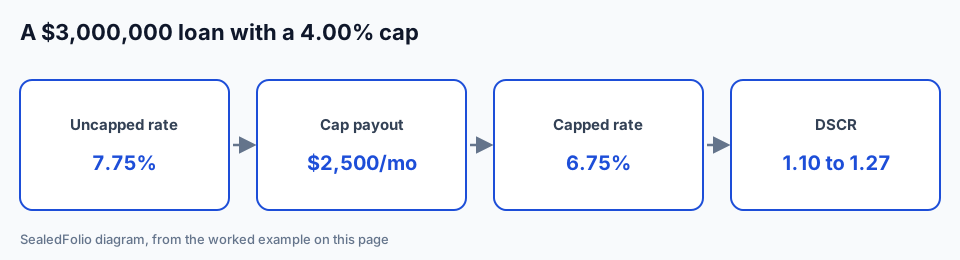
Diagram of the interest rate cap example: a 3,000,000 dollar loan at SOFR plus 2.75% uncapped at 7.75%, the cap paying 2,500 dollars a month, an effective 6.75% rate and DSCR rising from 1.10 to 1.27
A $3,000,000 loan with a 4.00% cap. Diagram by SealedFolio.
  1. The loan. $3,000,000 at SOFR plus 2.75%, interest only, on a building with $260,000 of NOI. The lender required a cap at a 4.00% strike.
  2. Without the cap. SOFR is 5.00%, so the all-in rate is 7.75%. A 30-day month costs $3,000,000 x 7.75% x 30 / 360 = $19,375.
  3. The cap pays. SOFR is 1.00% above the strike: $3,000,000 x 1.00% x 30 / 360 = $2,500 for the month.
  4. Net interest. $19,375 less $2,500 is $16,875, an effective 6.75%, the strike plus the spread.
  5. Coverage. A year of interest is about $235,729 uncapped and $205,313 capped. DSCR goes from 1.10 to 1.27, the difference between breaching a 1.20 covenant and passing it.

If SOFR falls below 4.00%, the cap pays nothing and the loan's rate falls with it. For a fixed-rate loan payment, use the mortgage calculator; for the building's yield on its value, the cap rate calculator (a different "cap"). Both sit alongside the rest of SealedFolio's free real estate calculators.

Tracking the loan after closing

In SealedFolio, each property's mortgage records the lender, original amount, current balance, rate, term, start date, monthly payment and notes, and the schedule of real estate owned shows DSCR and LTV per property. The rate is stored as you enter it: SealedFolio does not follow SOFR, model the cap or record cap payments separately, so update the rate and payment when the loan resets. Do not book cap payouts as property income: SealedFolio counts every income transaction in NOI, so that would overstate both NOI and DSCR. DSCR on the schedule of real estate owned uses the mortgage's monthly payment times 12. On an interest-only loan you can enter the monthly payment net of the cap payout to see the capped DSCR. On an amortizing loan, leave the contractual payment as it is, because SealedFolio splits each payment into interest and principal to track the balance and equity, and use the DSCR with cap from this calculator instead. More on loans across a portfolio is in commercial real estate software without the 50-unit minimum.

Keep every loan and its coverage in one place

SealedFolio Pro is $19 a month or $179 a year for up to 3 properties. Portfolio is $39 a month or $297 a year for unlimited properties. Both come with a 30-day money-back guarantee.

See SealedFolio pricing

Interest rate cap calculator: frequently asked questions

What is an interest rate cap?

A contract, often required by the lender on a floating-rate loan, that pays the borrower when the index (usually SOFR) rises above a strike rate. The loan still floats, but the cap's payments offset the interest above the strike, so the effective rate stops rising.

How is a cap payout calculated?

For each period: notional amount times (index minus strike, if positive) times the days in the period divided by 360. On a $3,000,000 cap with SOFR at 5.00% and a 4.00% strike, a 30-day month pays $2,500.

Does this calculator price the cap?

No. A cap's upfront cost depends on rate volatility, the term and the strike, and only a pricing model or a cap provider's quote gives it. Pensford and Chatham publish cap pricers. This calculator shows what the cap does to your interest and DSCR once you own it.

Why do lenders require a cap?

To protect debt service coverage. If SOFR rises, an uncapped floating loan can push DSCR below 1.0. The cap limits the all-in rate to the strike plus the loan spread.