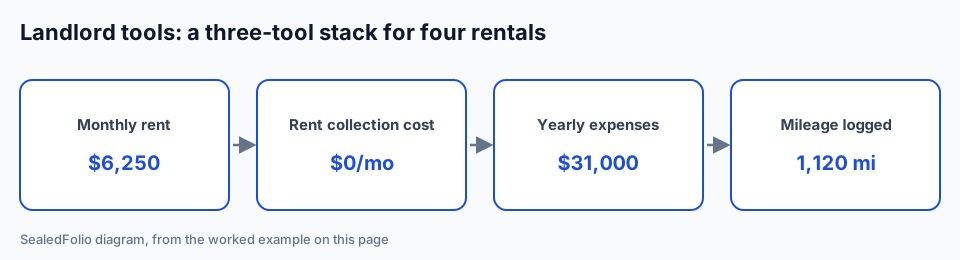
Running a few rentals means doing the books, collecting rent, screening tenants, keeping leases and fixing things, usually in the evenings. Here are the landlord tools for each of those jobs, what they cost, and a simple way to combine them without paying for a platform built for a management company.
Small landlords do best with a short stack: one place for the books and tax reports, one way to collect rent, a screening service, a lease template that fits your state or province, and a maintenance log. Free calculators cover buying and tax estimates. The books are the anchor, because everything else ends up there as income, expenses or a document.
SealedFolio is the books-and-records piece: a desktop app for Mac and Windows that keeps rental transactions, receipts, leases and mileage in an encrypted database on your computer and produces Schedule E and T776. It does not collect rent or screen tenants.
| Job | What the tool does | Typical cost model |
|---|---|---|
| Bookkeeping and tax | Categorizes income and expenses by property, stores receipts, produces Schedule E or T776 | Monthly or annual subscription; free tools earn from banking or payments |
| Rent collection | Tenants pay by bank transfer or card, with reminders and late fees | Per-transaction fees, often paid by the tenant |
| Tenant screening | Credit, criminal and eviction reports with the applicant's consent | Per report, usually paid by the applicant |
| Leases and e-signing | State or province specific lease templates, addenda and signatures | Per document or bundled with a platform |
| Maintenance | Work orders, vendor contacts and repair history per unit | Bundled with platforms or a simple log |
| Mileage log | Trips to rentals, hardware stores and the bank, at the IRS rate | Free apps or part of your bookkeeping tool |
| Calculators | Cap rate, cash flow, cash on cash, depreciation, 1031 and rent vs buy | Free |
These run in your browser, and the numbers you enter are not sent anywhere. All of them are listed on the free landlord calculators page.
Screening and leases are bought per applicant and per lease when a unit turns over. With SealedFolio as the books piece, the yearly software cost for four rentals is the Portfolio plan at $297 a year, since Pro at $179 a year covers up to 3 properties.
What it does not do: collect rent, screen tenants, sign leases or publish listings. For a ranked look at full platforms, see the best rental property software guide, and for private, offline options the local property management software page.
The books-and-records tool in your stack
SealedFolio Pro is $19 a month or $179 a year for up to 3 properties. Portfolio is $39 a month or $297 a year for unlimited properties. Both come with a 30-day money-back guarantee.
See SealedFolio pricingFive jobs need covering: bookkeeping and tax reports, rent collection, tenant screening, leases, and maintenance tracking. Add a mileage log, a place for receipts and documents, and a few calculators for buying decisions. One platform rarely does all of it well, so most landlords combine two or three tools.
Free calculators for cap rate, cash flow, cash on cash return, depreciation and 1031 exchanges handle most buying and tax estimates. Several online rent collection platforms have no monthly fee and charge tenants or charge per transaction instead. Free bookkeeping tools usually make money from banking, payments or upgrades, so check how before you rely on one.
With a few units, separate tools for each job are often cheaper and better than one platform built for management companies. Property management software starts to pay off when you have staff, owners to report to or dozens of units.
Most landlord platforms are web apps that store tenant and financial data on the vendor's servers. A desktop app such as SealedFolio keeps the books, receipts and leases in an encrypted database on your own computer.