Every year of depreciation lowers your tax on rental income and lowers your basis. When you sell, the IRS takes some of it back. Enter what you paid, what you claimed and what you expect to sell for, and see how the gain splits between recapture taxed up to 25% and long-term capital gain.
For a property held one year or less, the whole gain is short-term and taxed at your ordinary income rates, so this calculator does not apply.
| Adjusted basis | |
| Total gain | |
| Unrecaptured Section 1250 gain | |
| Remaining long-term capital gain | |
| Tax on recapture | |
| Capital gains tax | |
| Net investment income tax | |
| Estimated federal tax on the sale |
Federal estimate only. State income tax, suspended passive losses, installment sales and Section 1245 property (appliances, carpet, furniture) are not included. Check the figures with your tax preparer before you sell.
Your adjusted basis is what you paid, including closing costs, plus capital improvements, minus the depreciation allowed or allowable. Your gain is the sale price minus selling costs minus that adjusted basis.
The gain is then split in two. The part up to the depreciation you took on the building is unrecaptured Section 1250 gain, taxed at your ordinary income rate but never more than 25%. Whatever is left is long-term capital gain at 0%, 15% or 20%, depending on your taxable income. If the total gain is smaller than the depreciation, all of it is recapture.
Depreciation counts whether or not you claimed it. A landlord who skipped depreciation for years still has the basis reduced by what was allowable, so the recapture is owed without the deductions that should have offset it. If that is you, ask your preparer about Form 3115 before the sale year.
Residential rental buildings depreciate over 27.5 years and commercial buildings over 39 years, and land never depreciates. Use the rental property depreciation calculator to work out the depreciation to date if you do not have it from past returns.
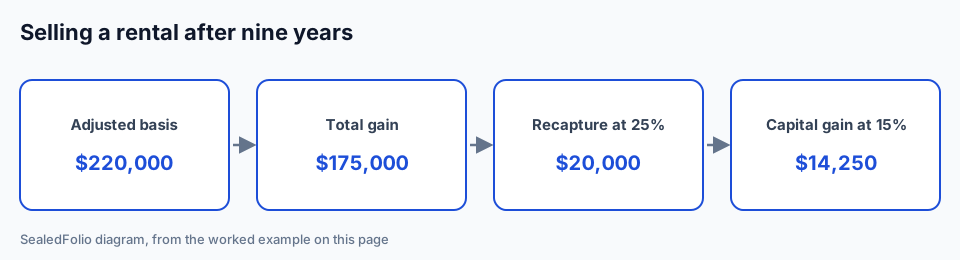
Without the recapture rule, the whole $175,000 would have been taxed at 15%, or $26,250. Recapture costs this seller $8,000 more, which is the depreciation benefit partly coming back. A 1031 exchange into another rental would defer all of it.
The hard part of a recapture estimate is rarely the math. It is finding the purchase closing statement, every capital improvement and each year's depreciation, often from returns filed by different preparers. SealedFolio keeps the purchase price, land percentage and placed-in-service date for each property, the depreciation that goes on Schedule E line 18 each year, and receipts for improvements in an encrypted database on your own computer. For the rest of the tax picture, start with the rental property tax deductions guide or browse the other free landlord calculators.
Depreciation records ready for the sale year
SealedFolio Pro is $19 a month or $179 a year for up to 3 properties. Portfolio is $39 a month or $297 a year for unlimited properties. Both come with a 30-day money-back guarantee.
See SealedFolio pricingWhen you sell a rental for a gain, the part of the gain that equals the depreciation you took (or could have taken) on the building is unrecaptured Section 1250 gain. It is taxed at your ordinary rate, capped at 25%, instead of the 0%, 15% or 20% long-term capital gains rate.
Yes. The IRS taxes depreciation allowed or allowable, so recapture is figured on the depreciation you were entitled to even if you did not claim it. Form 3115 can catch up missed depreciation before a sale.
No. 25% is the maximum rate for unrecaptured Section 1250 gain on real property. If your ordinary bracket is lower, the lower rate applies. Appliances, carpet and other personal property are Section 1245 property, and their recapture is taxed as ordinary income.
A like-kind exchange defers both the capital gain and the recapture into the replacement property. The deferred depreciation carries over and is taxed when the replacement is sold in a taxable sale.
It can. Rental gains count as net investment income when your modified adjusted gross income is over $200,000 single or $250,000 married filing jointly, unless you qualify as a real estate professional who materially participates.