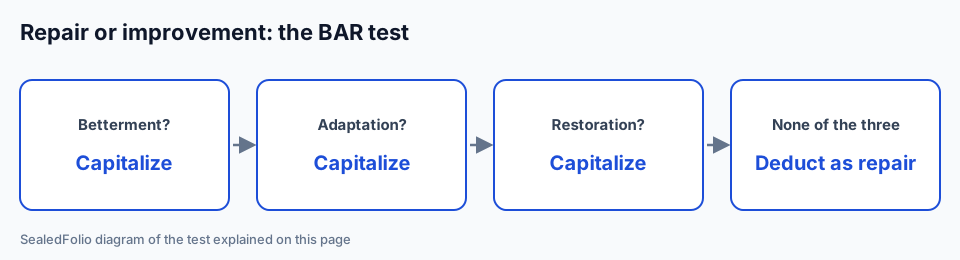
A $900 water heater fix is deducted this year. A $9,000 new roof is spread over 27.5 years. The difference comes from one test with three questions, plus three safe harbors that let small landlords deduct more right away. Here is how to sort each expense, with a table of common rental jobs.
The IRS treats spending as a capital improvement when it is a betterment (fixes a defect that existed when you bought it, enlarges the property or materially increases its capacity or quality), an adaptation to a new use, or a restoration (replaces a major component or returns a ruined property to working order). Everything else that keeps the property in its ordinary operating condition is a repair.
Repairs are deducted on Schedule E line 14 in the year paid. Improvements are added to basis and depreciated. The de minimis safe harbor ($2,500 per item or invoice), the routine maintenance safe harbor and the small taxpayer safe harbor let you deduct some spending that would otherwise be capitalized.
Before you ask whether something is a betterment, adaptation or restoration, you need to know what you are measuring against. The regulations split a building into the building structure and eight building systems: HVAC; plumbing; electrical; escalators; elevators; fire protection and alarms; security; and gas distribution. Each is its own unit of property.
This matters because replacing a major component of a system is a restoration. Replacing the entire furnace and air handler is a large part of the HVAC system, so it is an improvement. Replacing a blower motor is a small part of that system, so it is a repair, even though both jobs keep the heat running.
Condition at purchase matters too. Fixing a problem the property already had when you bought it, such as a leaking roof you knew about, is a betterment even if the same work done later would have been a repair. Those costs go into the purchase basis.
| Job | Usual treatment | Why | Where it goes |
|---|---|---|---|
| Patching a roof leak, replacing a few shingles | Repair | Keeps the roof in operating condition | Schedule E line 14 |
| Replacing the whole roof | Improvement | Restoration of a major component of the building structure | Depreciate over 27.5 years, line 18 |
| Repainting between tenants | Repair | Routine upkeep | Line 14 (or line 7 if done as cleaning and maintenance) |
| Fixing a burst pipe and the drywall around it | Repair | Returns damaged part to prior condition | Line 14 |
| Repiping the whole house | Improvement | Replaces most of the plumbing system | 27.5 years |
| Replacing a water heater | Often deductible | Under $2,500 per invoice it can be expensed under the de minimis election | Line 14 if de minimis, else 27.5 years |
| Replacing a dishwasher | Often deductible | 5-year property, but usually under the $2,500 de minimis limit | Line 14 if de minimis, else 5-year depreciation |
| Adding a bedroom or a deck | Improvement | Betterment: enlarges the property | 27.5 years (deck may be 15-year land improvement if detached) |
| Kitchen remodel with new cabinets and counters | Improvement | Betterment: materially increases quality | 27.5 years |
| Converting a garage into a rental unit | Improvement | Adaptation to a new use | 27.5 years |
| Servicing the furnace every year | Repair | Routine maintenance safe harbor | Line 14 |
Recovery periods for the improvement column are listed in our rental property depreciation recovery periods table.
If you do not have an applicable financial statement (an audited statement, essentially), you can elect to deduct any item or invoice of $2,500 or less. You make the election each year with a statement attached to a timely filed return, including extensions, and you must treat the items the same way in your books. A $1,800 refrigerator, a $1,200 window air conditioner and a $2,300 invoice for a new water heater installed all qualify. An invoice of $2,600 does not, and you cannot split one job into two invoices to get under the limit.
Recurring work that keeps a building system in its ordinary operating condition, and that you reasonably expect to do more than once in a ten-year period, can be deducted even if it involves replacing parts. Annual HVAC servicing, repainting on a five-year cycle and replacing worn carpet runners in a common hallway are typical. No election statement is needed, but betterments never qualify.
If a building's unadjusted basis is $1 million or less and your average gross receipts are $10 million or less, you can elect to deduct all repairs, maintenance and improvements on that building for the year if the total is not more than the lesser of $10,000 or 2% of the building's unadjusted basis. The election is made per building, per year.
In SealedFolio, Repairs is a category that flows to Schedule E line 14 and to the maintenance and repairs line on the Canadian T776. On the Portfolio plan you can open a CapEx project with a budget, assign each invoice to it, and run the CapEx report by property and date range, which gives your preparer a clean list of improvements to add to basis. Attach receipts to transactions and they stay encrypted on your computer. See landlord bookkeeping tips for the rest of the routine.
Repairs on line 14, improvements in a CapEx report
SealedFolio Pro is $19 a month or $179 a year for up to 3 properties. Portfolio, which adds CapEx projects, budgets and bulk import, is $39 a month or $297 a year for unlimited properties. Both come with a 30-day money-back guarantee.
See SealedFolio pricingThis guide explains general federal rules and is not tax advice. Classification depends on the facts of each job; confirm with a tax professional.
Replacing the whole roof is a restoration of a major component of the building, so it is a capital improvement depreciated over 27.5 years on a residential rental. Patching leaks or replacing a few damaged shingles is a repair you can deduct in the year you pay for it.
It is an annual election that lets you deduct items costing $2,500 or less per invoice or per item, if you do not have audited financial statements. You attach an election statement to a timely filed return each year and apply the same policy in your books.
If a building's unadjusted basis is $1 million or less and your average annual gross receipts are $10 million or less, you can deduct all repairs, maintenance and improvements on that building for the year, as long as the total is no more than the lesser of $10,000 or 2% of the building's unadjusted basis.
Deductible repairs go on Schedule E line 14. Capital improvements are not deducted on line 14; they are depreciated, and the yearly depreciation goes on line 18.
Yes. Repairs are a category that maps to Schedule E line 14. On the Portfolio plan you can also assign improvement spending to a CapEx project with a budget, and the CapEx report lists every capital transaction by property and project.