Rules from IRC section 469 and IRS Publication 925, read October 2026

Passive Activity Loss Rules
for Rental Property

A rental that shows a loss on Schedule E does not always lower your tax bill. The passive activity loss rules decide how much of that loss you can use this year and how much waits for a later year. This guide walks through the $25,000 allowance, the income phase-out, suspended losses and the two main exceptions, with a worked example.

Short answer: most landlords can deduct up to $25,000 of rental losses, if their income is under $150,000

Rental real estate is a passive activity unless you qualify as a real estate professional. Passive losses normally offset only passive income. The special allowance lets an owner who actively participates deduct up to $25,000 of rental losses against wages and other income each year.

The allowance shrinks by 50 cents for every dollar of modified adjusted gross income (MAGI) over $100,000 and is gone at $150,000. Any loss you cannot use is suspended, carried forward and released when you sell your entire interest in a fully taxable sale. The calculation happens on IRS Form 8582.

Why rental losses are passive in the first place

Section 469 of the Internal Revenue Code was written in 1986 to stop people from buying loss-producing investments purely to shelter their salary. It sorts income into three buckets: active income such as wages, portfolio income such as interest and dividends, and passive income from businesses you do not materially participate in. Rental activity is placed in the passive bucket by default, regardless of how many hours you spend on it.

That matters because a rental can show a paper loss while it produces cash. Depreciation is the usual reason. A building bought for $300,000 with $60,000 allocated to land produces about $8,727 a year of depreciation on the remaining $240,000, and that deduction does not cost you any cash in the year you take it. Add mortgage interest, property tax and repairs in a year with a vacancy, and Schedule E line 21 can easily go negative. Our rental property depreciation guide covers how that number is built.

Losses are only limited, not lost. The question is always timing: this year, a later year with passive income, or the year you sell.

The $25,000 special allowance and who qualifies

The special allowance is the part most small landlords rely on. To use it you must actively participate in the rental. Active participation is a much lower bar than material participation. You need to own at least 10% of the property by value (buying it partway through the year does not disqualify you), and you need to take part in management decisions in a real sense: approving new tenants, deciding rent, approving repairs and capital spending. Using a property manager is fine as long as you are still the one making those calls.

The allowance depends on your filing status and your MAGI. MAGI for this purpose is your adjusted gross income figured without the rental loss itself, IRA deductions, taxable Social Security and a few other items listed in the Form 8582 instructions.

Filing statusMaximum allowancePhase-out startsAllowance is zero at
Single, head of household, married filing jointly$25,000$100,000 MAGI$150,000 MAGI
Married filing separately, lived apart all year$12,500$50,000 MAGI$75,000 MAGI
Married filing separately, lived together at any time in the year$0Not availableNot available

The phase-out rule is simple arithmetic: subtract the phase-out start from your MAGI, halve the result, and take that off the maximum allowance. The thresholds are written into the statute and are not indexed for inflation, so they have been the same since 1986.

Worked example: two rentals, an $18,000 loss and $120,000 of MAGI
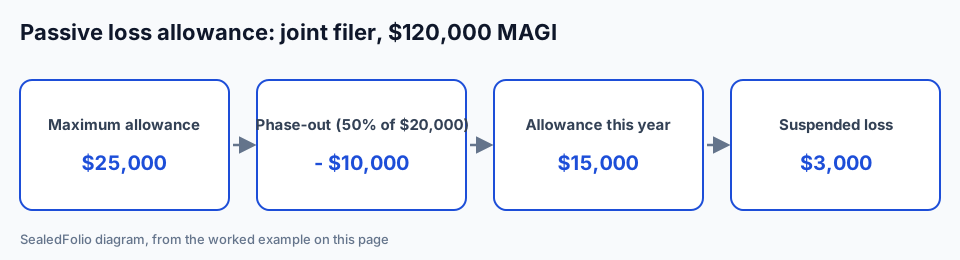
Diagram of the passive activity loss allowance worked example: a 25,000 dollar maximum reduced by a 10,000 dollar phase-out leaves 15,000 dollars deductible and 3,000 dollars of rental loss suspended
Passive loss allowance: joint filer, $120,000 MAGI. Diagram by SealedFolio.

Maria files jointly. Her household MAGI is $120,000. She owns a duplex outright and a single-family rental with a mortgage, and makes every leasing and repair decision herself. Her Schedule E for the year looks like this:

LineDuplexSingle-familyTotal
Rents received (line 3)$31,200$19,800$51,000
Expenses before depreciation$24,600$23,400$48,000
Depreciation (line 18)$9,800$11,200$21,000
Income or loss (line 21)($3,200)($14,800)($18,000)
  1. Start with the maximum. Joint filer, active participant: $25,000.
  2. Apply the phase-out. $120,000 minus $100,000 is $20,000. Half of that is $10,000, so her allowance is $25,000 minus $10,000, or $15,000.
  3. Compare with the loss. Her net rental loss is $18,000. She deducts $15,000 against her other income this year.
  4. Carry the rest. The remaining $3,000 is a suspended loss. Form 8582 allocates it between the two properties in proportion to their losses, so about $533 is attached to the duplex and about $2,467 to the single-family home.

If Maria's MAGI had been $155,000, none of the loss would be deductible this year and all $18,000 would carry forward. If it had been $95,000, she would deduct the full $18,000. The per-property split in step 4 is why it helps to keep each property's income and expenses separate all year: the suspended amount follows the property, and it is released when that specific property is sold.

Suspended losses: where they go and how you get them back

A suspended passive loss carries forward with no expiry date. Each year it is added to that property's new result on Form 8582. It can be used in three ways:

A 1031 exchange is not a fully taxable disposition, so suspended losses generally stay with the replacement property instead of being freed. Gifting a property also does not release them; they are added to the property's basis instead. Selling to a relative or a company you control is not treated as a sale to an unrelated party.

The two big exceptions: real estate professionals and short-term rentals

Real estate professional status

If more than half of your personal working hours, and more than 750 hours in the year, are spent in real property trades or businesses in which you materially participate, you can qualify as a real estate professional. Your rentals are then not automatically passive. You still need to materially participate in the rentals themselves, and most professionals file an election to treat all their rentals as one activity so the hour tests are easier to meet. Someone with a full-time W-2 job in another field almost never qualifies. Keep a contemporaneous time log; it is the first thing an examiner asks for.

Short-term rentals with average stays of seven days or less

Under the Treasury regulations, a property where the average guest stay is seven days or less is not a rental activity for passive loss purposes. It is treated like any other business, so if you materially participate (for example, more than 100 hours and more than anyone else, including cleaners) its losses are not passive. This is the basis of the short-term rental strategy you will see discussed by CPAs. The details are fact-specific, so take this one to your preparer.

What to keep for each property so Form 8582 is easy

Your preparer or tax software applies the limit, but they need clean inputs. For every property you need its Schedule E income or loss, any suspended loss carried from last year, the date you acquired it, and whether you sold it. If you co-own a property, you need your ownership percentage too, because the 10% active participation test depends on it.

SealedFolio keeps each property's rent, expenses, mortgage interest and depreciation separately and builds a per-property Schedule E report for the year, which you can export to CSV or PDF for your preparer. It does not calculate the passive loss limit, because that depends on the rest of your return. It does give you the property-level numbers Form 8582 asks for, from records that stay encrypted on your own computer.

For the full list of deductions that feed these numbers, see the 2026 rental property tax deductions guide. For a quick estimate of a single property, try the Schedule E calculator.

Per-property books for landlords, kept on your computer

SealedFolio Pro is $19 a month or $179 a year for up to 3 properties. Portfolio is $39 a month or $297 a year for unlimited properties. Both come with a 30-day money-back guarantee.

See SealedFolio pricing

This guide explains general federal rules and is not tax advice. Rules for your situation, including state treatment, can differ; confirm with a tax professional.

Passive activity loss rules for rental property: frequently asked questions

Are rental property losses deductible against my salary?

Only within limits. Rental real estate is a passive activity by default, so a rental loss normally offsets only passive income. The main exception is the special allowance of up to $25,000 for owners who actively participate, which phases out between $100,000 and $150,000 of modified adjusted gross income.

What happens to a rental loss I cannot deduct this year?

It becomes a suspended passive loss. It carries forward with no time limit, offsets passive income in later years, and is released in full when you sell your entire interest in the property to an unrelated buyer in a fully taxable sale. If you grouped rentals as one activity, the losses are released when the whole activity is sold.

What counts as active participation?

You own at least 10% of the property and take part in management decisions in a real sense, such as approving tenants, setting rents and approving repairs or capital spending. Hiring a property manager does not remove active participation if you still make those decisions.

How is the $25,000 allowance reduced?

The allowance drops by $1 for every $2 of modified adjusted gross income above $100,000, so it reaches zero at $150,000. Married people filing separately who lived apart all year get half the amounts; those who lived together at any time in the year get no allowance.

Does SealedFolio calculate my passive loss limit?

No. SealedFolio produces the per-property Schedule E figures, so you can see each property's net income or loss for the year. The passive loss limit depends on your whole return, so it is applied on Form 8582 in your tax software or by your preparer.