Based on IRS Publications 463 and 527, read October 2026

The Landlord Mileage Deduction
What Counts and How to Log It

Landlords who manage their own properties drive a lot: showings, repairs, hardware store runs, inspections. Those miles are deductible, and at 70 cents a mile for 2025 they add up fast. The catch is the log. This guide covers which trips count, which method to pick and what the IRS expects to see.

Short answer: yes, rental driving is deductible on Schedule E line 6

Miles you drive for the rental activity are deductible local transportation. Multiply them by the IRS standard mileage rate (70 cents a mile for 2025), or deduct the rental share of your actual car costs. Parking and tolls for those trips are deductible on top of either method.

You need a record made at or near the time of each trip: the date, where you went, the business purpose and the miles. Without it, the deduction is easy for an examiner to disallow.

Which trips count and which do not

TripDeductible as rental expense?Notes
Driving to the rental to fix a leak or meet a plumberYesThe most common rental trip.
Showing a vacant unit to applicantsYesLog each showing day.
Hardware store run for supplies for the rentalYesIf the stop is part of a personal errand, count only the extra miles.
Move-in or move-out inspectionYes
Bank deposit of rent checksYesSmall, but it adds up over a year.
Meeting your accountant or attorney about the rentalsYes
Looking at properties you might buyNot on Schedule EInvestigation and acquisition costs are generally capitalized into a property you buy.
Trip that is mostly personal with a quick stop at the rentalOnly the extra milesThe detour, not the whole trip.
Long-distance travel to an out-of-town rentalYes, with limitsLodging and meals rules apply; the primary purpose must be the rental.

Having a W-2 job does not by itself make rental trips deductible. Home-to-rental trips are deductible when your home is the principal place of business for the rental activity, or when the rental is a temporary work location you visit only occasionally. Otherwise the first trip of the day from home to a rental you work at regularly can be nondeductible commuting, while trips between rentals are deductible. A landlord who rents an office for the rental business treats that office as the starting point instead.

Standard mileage rate or actual expenses

The standard mileage rate covers gas, maintenance, insurance and depreciation in one number. It is the simple choice and the one most small landlords use. The IRS sets it each year; it was 67 cents for 2024 and 70 cents for 2025.

The actual expense method adds up what the car really cost (gas, oil, repairs, tires, insurance, registration, lease payments or depreciation) and deducts the rental-use percentage. It can win with an expensive vehicle that is used heavily for the rentals, but you need the receipts and the total miles for the year, not only the rental miles.

Two rules to remember. If you want to use the standard rate for a car you own, you must choose it in the first year you use that car for the rental. And once you have used the actual method with accelerated depreciation on a car, you cannot switch that car to the standard rate later.

Worked example: three rentals, one year of trips

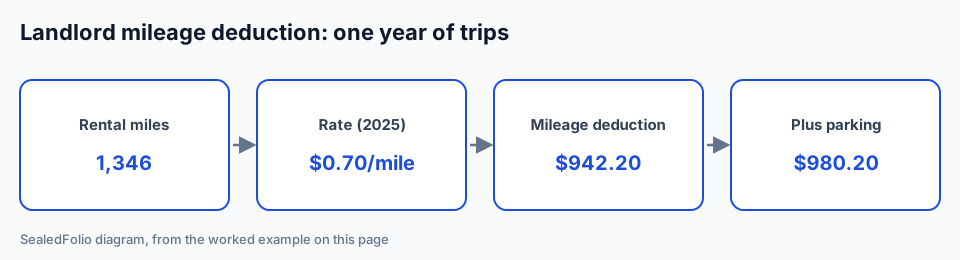
Diagram of the landlord mileage deduction worked example: 1,346 rental miles at 70 cents a mile is 942.20 dollars, 980.20 dollars with parking
Landlord mileage deduction: one year of trips. Diagram by SealedFolio.

Dev owns three rentals 6, 11 and 18 miles from home and manages them himself. His log for 2025:

Trip typeTripsRound-trip miles eachMiles
Repairs and contractor visits3422 average748
Showings during two vacancies936324
Supply runs (extra miles only)188 average144
Move-in and move-out inspections429 average116
Accountant meeting11414
Total661,346
  1. Total the log. 66 trips add up to 1,346 rental miles for the year.
  2. Apply the rate. 1,346 miles times $0.70 is $942.20.
  3. Add parking and tolls. He paid $38 of parking during showings, so line 6 is $980.20.
  4. Split by property. Each trip is tagged to the property it served; the 14-mile accountant trip served all three, so $3.27 of its $9.80 goes to each.

If Dev's rentals produce a loss, this deduction is part of that loss and is subject to the passive activity loss rules.

What a mileage log needs, and how SealedFolio keeps it

The IRS asks for adequate records made at or near the time of the trip. For each trip, that means the date, the destination, the business purpose and the miles. A notebook in the glove box works. Reconstructing a year of trips from memory in April does not hold up well.

SealedFolio has a mileage tracker on both plans. You log a trip with its date, start and destination, miles, purpose and the property it was for. The app looks up the IRS rate stored for that year, shows the deduction for the trip before you save it, and totals miles and deduction for the year. For 2022, when the IRS raised the rate midyear, the app applies 58.5 cents to every trip, so recalculate trips from July 1 to December 31, 2022 at 62.5 cents. The app also stores 70 cents, the 2025 rate, for 2026 trips, so check the IRS rate for 2026 and recalculate the year total if it differs. The records stay in SealedFolio's encrypted database on your computer, next to the rent, expenses and receipts for the same property. The tracker keeps its own totals and does not post to the Schedule E report by itself: it shows one year total across all your rentals, with no per-property breakdown, so with more than one rental keep your own per-property tally of miles (a notebook column or a spreadsheet works). Then record each property's mileage deduction (plus parking and tolls) as an expense in the Mileage or Tolls & Parking category for that property, and it lands on line 6.

Canadian landlords claim motor vehicle expenses on the T776 instead, using actual costs rather than a per-mile rate. For other deductions, see the 2026 rental property tax deductions guide.

Mileage, receipts and Schedule E for your rentals

SealedFolio Pro is $19 a month or $179 a year for up to 3 properties. Portfolio is $39 a month or $297 a year for unlimited properties. Both come with a 30-day money-back guarantee.

See SealedFolio pricing

This guide explains general federal rules and is not tax advice. Confirm the current year's mileage rate and your own situation with a tax professional.
Landlord mileage deduction: frequently asked questions

Can landlords deduct mileage?

Yes. Driving you do for the rental activity, such as trips to the property for repairs, showings, inspections, buying supplies or meeting a contractor, is deductible. You can use the IRS standard mileage rate or your actual car expenses, and the deduction goes on Schedule E line 6.

What was the IRS standard mileage rate for 2025?

70 cents a mile for business use, including rental activity. The IRS announces each year's rate in a notice near the end of the previous year, so check the current notice before filing.

Is driving from my home to my rental property deductible?

Generally yes, when the trip is for the rental activity. It depends on where your business is based. If your home is your principal place of business for the rental activity (you run it from a home office), trips from home to a rental for rental work are deductible. Without that, the first trip from home to a rental you work at regularly can be nondeductible commuting, while a trip to a rental you visit only occasionally (a temporary work location) is deductible. Ask your preparer which applies to you.

Can I deduct trips to look at properties I might buy?

Not as a rental expense on Schedule E. Costs of investigating and acquiring a new property are generally capitalized into the cost of that property if you buy it. Keep the log anyway and ask your preparer how to treat them.

Does SealedFolio track mileage?

Yes, on both plans. The mileage tracker logs each trip with date, start, destination, miles, purpose and property, multiplies the miles by the IRS rate stored for that year, and totals the deduction by year. For 2026 trips it currently stores 70 cents, the 2025 rate, so check the IRS rate for 2026 and recalculate if it differs.