For owners of a few commercial buildings

Commercial Real Estate Risk Assessment Software
Six Risks to Score Every Quarter

Enterprise risk platforms model markets, climate and credit across hundreds of assets. A small owner's risks are closer to home, and almost all of them can be read from your own books. Here are the six that matter, a worked scorecard and what SealedFolio keeps current.

The six risks and how to measure them

RiskMeasureWarning signIn SealedFolio
Tenant concentrationLargest tenant's share of rentAbove 25 to 30%Rent roll by tenant
Lease rolloverShare of rent expiring in 24 monthsAbove 30%Lease end dates; leases ending in 30 days flagged
DebtDSCR, LTV, months to maturityDSCR under 1.25, maturity inside 24 monthsMortgages per property; DSCR and LTV on the SREO
InsuranceCoverage against value, renewal dateCoverage below replacement costPolicies with coverage, deductible and end date on the dashboard
VacancyVacant units and months vacantAbove market vacancyVacancy periods per unit
Capital needsPlanned CapEx against reservesRoof, HVAC or parking due with no budgetCapEx projects with budget, spent and remaining

Market, climate and tenant credit risk need outside data, and SealedFolio does not pull it. The live SERP for this search is led by enterprise platforms such as MRI and Agora and by property-risk data vendors such as Archipelago for that reason.

Worked example: a two-building scorecard
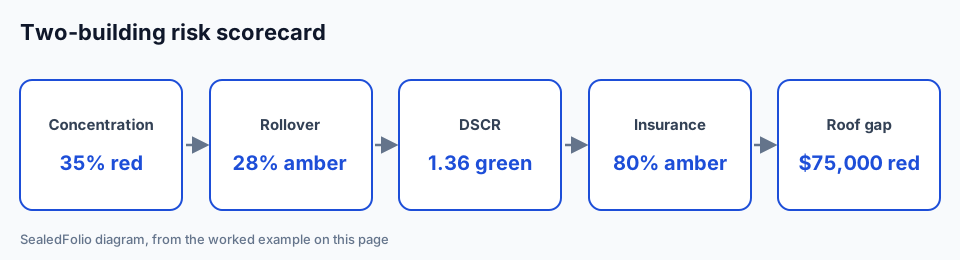
Diagram of a two-building commercial risk scorecard: largest tenant 35% of rent in red, 28% of rent rolling in 24 months in amber, DSCR 1.36 in green, insurance at 80% of replacement cost in amber and a 75,000 dollar roof reserve gap in red
Two-building risk scorecard. Diagram by SealedFolio.
  1. Concentration. Rent is $34,000 a month across both buildings. A medical tenant pays $11,900 of it, 35%: red.
  2. Rollover. Leases paying $9,520 a month end inside 24 months, 28% of rent: amber.
  3. Debt. NOI of $290,000 against $214,000 of debt service is a DSCR of 1.36, and the loan matures in 41 months: green.
  4. Insurance. The flex building is insured for $1,600,000, but replacement cost is now about $2,000,000, an 80% coverage ratio: amber, raise it at the renewal in 3 months.
  5. Capital. A $120,000 roof is due in 2 years with $45,000 set aside, a $75,000 gap: red.

Two reds point to the two actions: start the medical tenant's renewal early, and fund the roof reserve before the refinance. For the loan side, see commercial real estate valuation software and the mortgage calculator.

Where SealedFolio fits

SealedFolio keeps the inputs to every row of the scorecard in one encrypted vault on your own Mac or Windows PC: the rent roll, lease dates, vacancy periods, mortgages, insurance policies and CapEx projects, with DSCR and LTV per property on the schedule of real estate owned. It does not compute a risk score, pull market data or send alerts beyond the dashboard's upcoming lease endings and policy renewals.

The SREO, budgets and CapEx are on the Portfolio plan. Where the leases, policies and loan papers behind these numbers live is covered in commercial real estate document management. For the rest of the commercial setup, see commercial real estate software without the 50-unit minimum.

Every risk input, from your own books

SealedFolio Pro is $19 a month or $179 a year for up to 3 properties. Portfolio is $39 a month or $297 a year for unlimited properties. Both come with a 30-day money-back guarantee.

See SealedFolio pricing

Commercial real estate risk assessment software: frequently asked questions

What is commercial real estate risk assessment software?

Software that scores the risks on each property and across a portfolio: how much income depends on one tenant, how much rent rolls over soon, how close the loan is to its covenants, whether insurance is current and adequate, how much space is vacant and what capital work is coming.

What are the main risks for a small commercial property?

Tenant concentration, lease rollover, debt maturity and covenants, insurance gaps, vacancy and deferred capital work. Market and climate risk matter too, but they need outside data sources.

How often should I assess risk on a commercial property?

Quarterly is a sensible rhythm for a small owner, and again before any refinance, renewal negotiation or insurance renewal.

Does SealedFolio score risk automatically?

No. It keeps the inputs current: rent roll, lease end dates, vacancy periods, mortgages with DSCR and LTV, insurance policies with coverage and end dates, and CapEx budgets. You read the scorecard from those numbers.