For owners of a few commercial buildings

Commercial Real Estate Document Management Software
File It Once, Find It at Refinance

The documents behind a commercial building decide your basis, your tenants' obligations and your lender's covenants. When a refinance or a sale comes, they all have to be found at once. Here is what to keep, how to file it and where SealedFolio fits.

What to keep, by property

DocumentWhy it mattersKeep until
Deed and closing statementSets purchase price and basis3+ years after the sale is reported
Loan documentsRate, maturity, covenants, reservesLoan payoff, then 3+ years
Leases, amendments, estoppelsRent, term, options, obligationsLease end plus the claim period
Insurance policies and tenant COIsProof of coverage for lender and claimsPolicy end plus the claim period
Property tax bills and appealsExpense and tenant pass-through3+ years after filing
Repair and improvement receiptsDeductions, basis and depreciation3+ years after the sale is reported

Retention periods here are common practice, not legal advice; your accountant and lender may require longer. Why improvement receipts matter for basis is explained in rental property depreciation.

Worked example: a refinance package for one building
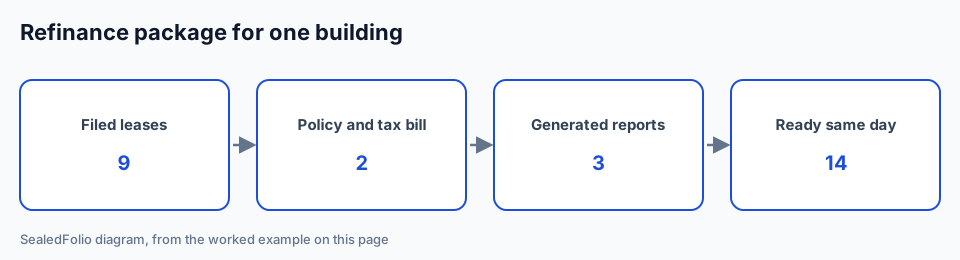
Diagram of a refinance document package: 9 filed leases plus an insurance policy and tax bill, 3 reports generated from the books, 14 documents ready the same day
Refinance package for one building. Diagram by SealedFolio.
  1. The request. The lender asks for 6 items on a 9-tenant office building: current rent roll, all 9 leases, 2 years of operating statements, the insurance policy, the latest tax bill and the existing loan statement.
  2. Filed by property and type. The 9 leases, 1 policy and 1 tax bill are already attached to the building, so they are 11 files to export.
  3. Generated, not filed. The rent roll and two years of income statements come from the books as reports, so there are 3 more files that never need to be scanned.
  4. Result. 14 of the lender's documents are ready the same day. Only the loan statement comes from the lender's portal.

Where SealedFolio fits

SealedFolio stores each document in its vault on your own Mac or Windows PC, encrypted per file with XChaCha20-Poly1305 and attached to a property. When a document is scanned, it is read with on-device text recognition (Apple Vision on Mac, Windows OCR on Windows) and classified as a lease, closing document, tax bill, insurance, receipt or appraisal, and the fields it finds wait for you to confirm before they become transactions. Nothing is uploaded to a cloud service.

It is not an enterprise repository: there is no data room, e-signature, version control or shared access for a team, so export files to send them. Rent rolls and income statements come from the same books, and the same records feed a quarterly risk scorecard. More of the commercial setup is in commercial real estate software without the 50-unit minimum and local property management software.

Every lease and receipt, encrypted on your own computer

SealedFolio Pro is $19 a month or $179 a year for up to 3 properties. Portfolio is $39 a month or $297 a year for unlimited properties. Both come with a 30-day money-back guarantee.

See SealedFolio pricing

Commercial real estate document management: frequently asked questions

What documents does a commercial property owner need to keep?

Per property: the deed and closing statement, loan documents, every lease with its amendments and estoppels, insurance policies and tenant certificates of insurance, property tax bills, service contracts, and receipts for repairs and improvements.

How long should I keep commercial property records?

Keep acquisition, improvement and depreciation records for as long as you own the property plus at least three years after you report the sale, because they set your basis and recapture. Keep leases for the term plus the period a claim could still be made.

What is a commercial real estate document repository?

One organized store for every document on every property, filed by property and type, so a lender, buyer or accountant request can be answered quickly. Enterprise platforms add data rooms, e-signature and permissions.

Is SealedFolio a document management system?

For a small owner's own files, yes: documents are encrypted per file, attached to a property and classified by type when scanned (lease, closing document, tax bill, insurance, receipt or appraisal). It has no data room, e-signature or shared access.