For landlords who keep their own books

Rental Property Bookkeeping Software
What It Must Do, With a Worked Month

Rental bookkeeping is not hard, but generic accounting software makes it harder than it needs to be. Here are the seven things rental property bookkeeping software has to get right, a worked month for a duplex and where SealedFolio fits.

Seven things the software has to get right

RequirementWhy it mattersWhat to test in a demo
Categories on the tax form linesYear end is a report, not a re-sortIs there a Schedule E (or T776) category list built in?
Per-property trackingSchedule E is filed per propertyCan one transaction be assigned to one property?
Bank importTyping transactions is where errors come fromDoes it read your bank's CSV, OFX or QFX file?
Receipts with transactionsAn audit asks for the receipt, not the totalCan you attach a scan to the expense?
Mortgage interest split from principalOnly interest is deductibleDoes a payment split into interest and principal?
Mileage logTrips to the property are deductible with a logIs there a dated trip log?
Statements beyond taxLenders ask for an income statement and balance sheetCan it export both?

The routine that sits on top of the software, from a separate bank account to the monthly reconcile, is in SealedFolio's rental property bookkeeping system for landlords.

Worked example: October 2026 for a duplex

A duplex with two tenants. These are the month's bank lines and the Schedule E line each one belongs on.

Bank lineAmountSchedule E line
Rent, unit A$1,650Line 3, rents received
Rent, unit B$1,550Line 3, rents received
Mortgage payment $1,400: interest$812Line 12, mortgage interest
Mortgage payment $1,400: principal$588Not an expense; reduces the loan balance
Landlord insurance$118Line 9, insurance
Water and sewer$96Line 17, utilities
Plumber, leaking supply line$240Line 14, repairs
Listing ad for the spring vacancy$35Line 5, advertising
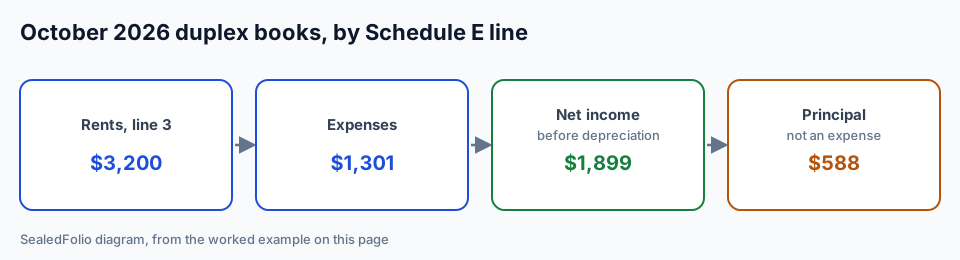
Diagram of one month of duplex bookkeeping: 3,200 dollars rent on line 3, 1,301 dollars of expenses across lines 5, 9, 12, 14 and 17, 1,899 dollars net before depreciation, and 588 dollars of principal kept off the expense lines
One month of duplex books by Schedule E line. Diagram by SealedFolio.

Rents are $3,200. Expenses are $1,301: $812 + $118 + $96 + $240 + $35. Net before depreciation is $1,899. The bank shows only $1,311 left after the $1,889 that went out, because $588 of that was principal, which is not an expense. Software that books the whole $1,400 payment as an expense understates profit by $588 this month, about $7,000 a year.

Depreciation goes on line 18 once a year, not monthly. The rental property depreciation calculator works out the annual figure.

General accounting software or rental software

General small-business software can do all of this once you rebuild its chart of accounts around the Schedule E lines and add a class or location per property. Many landlords do exactly that. The cost is setup time and a monthly fee sized for businesses with payroll and invoicing you do not need.

Rental software starts with the tax lines and properties built in. The comparison with the best-known general option is in SealedFolio vs QuickBooks.

Where SealedFolio fits

SealedFolio covers the seven on every paid plan, with one difference: receipts are stored with the property rather than attached to a single transaction. Expense categories follow Schedule E, or T776 for Canadian rentals. Bank transactions come in from CSV, OFX, QFX or QIF files, or through an optional Plaid connection that uses your own Plaid API credentials. Receipts are scanned with on-device OCR and kept, encrypted, with the property they belong to. Mortgages split each payment into interest and principal. A mileage log, the income statement, balance sheet and general ledger round it out, with CSV export. Importing several files at once and custom tags are on the Portfolio plan.

Your books stay in an encrypted vault on your own Mac or Windows PC, the same vault that holds the rent roll and tenant files in SealedFolio's local property management software. For the rest of a self-managing landlord's setup, see SealedFolio for landlords.

Rental books that are ready at tax time

SealedFolio Pro is $19 a month or $179 a year for up to 3 properties. Portfolio is $39 a month or $297 a year for unlimited properties. Both come with a 30-day money-back guarantee.

See SealedFolio pricing

Rental property bookkeeping software: frequently asked questions

What is the best bookkeeping software for a rental property?

For a landlord with a few properties, the best fit is software whose categories match Schedule E (or T776 in Canada), that imports your bank transactions, keeps receipts with each transaction and produces the year-end tax report without an accountant re-sorting everything. General small-business software works but needs its chart of accounts rebuilt.

Can I do rental property bookkeeping myself?

Yes. Most small landlords do. Use one bank account per rental business, record each transaction with its Schedule E category when it happens, keep the receipt, and reconcile once a month. The twelve-step system in SealedFolio's rental property bookkeeping guide covers the routine.

Is the mortgage payment a rental expense?

Only the interest is. The principal part of each payment reduces the loan balance and is not deductible. Good bookkeeping software splits the two so the interest lands on Schedule E line 12 and the principal stays off the expense lines.

How does SealedFolio import bank transactions?

From a CSV, OFX, QFX or QIF file exported from your bank, or through an optional Plaid bank connection that uses your own Plaid API credentials. Importing several files at once is on the Portfolio plan. Imported data is stored on your computer.