For owners of a few commercial buildings

Commercial Real Estate Reporting Software
The Seven Reports a Small Owner Needs

Enterprise reporting suites build dashboards for asset managers with hundreds of buildings. If you own two or five, you need seven reports that are right every month, and the ones your lender asks for at renewal. Here they are, with a worked quarterly report and what SealedFolio produces.

The seven reports, who reads them and how often

ReportWhat it answersWho reads itHow often
Operating statement (income statement)Rent collected, operating expenses and NOI per buildingYou, your accountant, lendersMonthly, plus trailing twelve months
Rent rollWho pays what, lease start and end, deposits, vacant unitsLenders, buyers, insurersMonthly and on request
Budget vs actualWhere spending ran over or under planYou and any partnersQuarterly
Debt coverageDSCR and LTV per building against the loan covenantsLendersQuarterly and before a refinance
Capital projectsBudget, spent and remaining on roofs, HVAC and parkingYou and lenders holding reservesQuarterly
Cash flow by monthMoney in and out after debt serviceYouMonthly
Schedule of real estate ownedEvery property with value, debt, income and coverage on one pageLenders at every new loan or renewalOn request

Lease expiry is not a separate report here because it sits on the rent roll: sort by lease end date and the next twelve months of rollover is the top of the list. What belongs on the rent roll itself is covered in rent roll software, and how the same numbers feed a value estimate in commercial real estate valuation software.

A dashboard is useful for spotting a problem, but the reports are what you send. Before buying software for its charts, check that it produces each of the seven as a file you can export and hand over.

Worked example: a Q3 2026 owner report for two buildings

Two buildings, a four-unit retail strip and an eight-suite office, twelve units in all. These are the quarter's figures, worked by hand from the operating statement, rent roll, budget and loan papers.

LineQ3 2026How it is worked out
Rent billed$96,000From the rent roll: $32,000 a month for 3 months
Rent collected$93,60097.5% of billed; one office tenant $2,400 behind
Operating expenses$31,200Taxes, insurance, utilities, repairs, management
Expense budget$28,500$2,700 over (9.5%), mostly a $2,400 HVAC repair
NOI$62,400$93,600 collected minus $31,200 expenses
Debt service$45,000$15,000 a month across both loans
DSCR for the quarter1.39$62,400 divided by $45,000; covenant is 1.25
Occupancy91.7%11 of 12 units leased
Roof project$38,000 left$60,000 budget, $22,000 spent
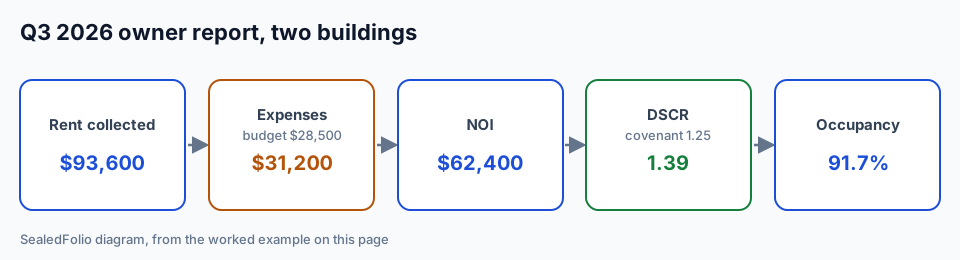
Diagram of a Q3 2026 owner report for two commercial buildings: 93,600 dollars rent collected, 31,200 dollars expenses against a 28,500 dollar budget, NOI of 62,400 dollars, DSCR of 1.39 against a 1.25 covenant and 91.7 percent occupancy
Quarterly owner report for two buildings. Diagram by SealedFolio.

Three things in this report need action: the $2,400 arrears, the HVAC overspend, which pushes the year's repair budget, and the vacant suite. The DSCR of 1.39 clears the 1.25 covenant, but one more vacancy at the office would bring it close.

The DSCR here is for one quarter. SealedFolio's schedule of real estate owned works DSCR from the last twelve months of income against the mortgage payments times twelve, which is the view most lenders use.

What to check before you buy reporting software

  1. Per-building and portfolio views. Every report should run for one property or all of them.
  2. Exports you can send. A lender wants a file, not a login. Check CSV or PDF export for each report.
  3. Budget against actual. Without a budget, an overspend shows up only at year end.
  4. Debt metrics from your own loans. DSCR and LTV should come from the mortgages you entered, not a manual spreadsheet.
  5. Where the data lives. Cloud reporting tools hold your rent roll and tenant data on their servers. Decide whether that is acceptable for your tenants' details.
  6. Price for your size. Many commercial suites have unit minimums or per-unit pricing built for large portfolios.

Where SealedFolio fits

SealedFolio produces three of the seven reports on every paid plan: the income statement as the operating statement, the rent roll and cash flow by month, along with the balance sheet, general ledger and Schedule E or T776 for tax. The other four, budget against actual, the CapEx report, and the schedule of real estate owned with DSCR and LTV per property, are on the Portfolio plan, so a commercial owner who wants all seven needs Portfolio. The income statement, balance sheet, general ledger and transactions export as CSV, and Schedule E and T776 export as CSV or PDF.

It runs on your own Mac or Windows PC in an encrypted vault. It has no investor portal, distribution waterfall, CAM reconciliation or market data, so a fund reporting to outside investors needs a different tool. For the rest of the commercial setup, see commercial real estate software without the 50-unit minimum.

Your owner reports, from your own books

SealedFolio Pro is $19 a month or $179 a year for up to 3 properties. Portfolio is $39 a month or $297 a year for unlimited properties. Both come with a 30-day money-back guarantee.

See SealedFolio pricing

Commercial real estate reporting software: frequently asked questions

What is commercial real estate reporting software?

Software that turns the rent, expense, lease and loan records for each building into the reports owners, lenders and partners read: an operating statement, a rent roll, budget against actual, debt coverage, capital projects and a schedule of real estate owned.

Which reports does a lender ask a commercial owner for?

Usually a current rent roll, a trailing-twelve-month operating statement, a schedule of real estate owned listing every property with its value, debt and coverage, and the latest tax returns. Some lenders also ask for a budget for the coming year.

How often should a small commercial owner run reports?

Monthly for the operating statement and rent roll, quarterly for budget against actual and debt coverage, and whenever a lender, insurer or partner asks. A quarterly owner report is a good habit even for two buildings.

Does SealedFolio produce investor or partner reporting portals?

No. SealedFolio has no investor portal, distribution waterfall or partner login. It produces the reports on your own computer and exports the income statement, balance sheet, general ledger and transactions as CSV, and Schedule E and T776 as CSV or PDF, so you can send them to whoever needs them.