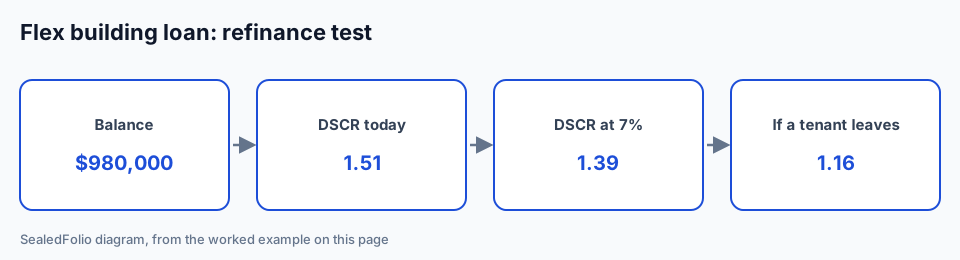
On a commercial property the loan, not the tenant, is usually what forces a decision: a maturity date, a rate reset or a covenant test. Here is what to track for each loan, a worked refinance example and how SealedFolio records it.
A home mortgage runs 30 years and nobody tests it. A commercial loan often runs 5 to 10 years with a balloon at the end, may reset its rate partway through, and carries covenants: a minimum debt service coverage ratio and a maximum loan to value. Miss one and the lender can sweep cash or call the loan.
Institutional debt platforms track hundreds of loans with covenant models and lender reporting. An owner with two or three loans needs the same dates and ratios kept current, next to the property's books.
| Field | Why it matters | In SealedFolio |
|---|---|---|
| Lender, original amount, start date, term | Gives the maturity or balloon date | Stored per mortgage |
| Current balance | Drives LTV and the refinance amount | Stored; you update it from statements |
| Interest rate and monthly payment | Annual debt service for DSCR | Stored per mortgage |
| Escrow | Taxes and insurance paid through the lender | Stored per mortgage |
| DSCR and LTV | The two usual covenants | Shown per property on the SREO |
| Covenant thresholds and reset dates | Tells you how close you are | Not modeled; keep them in the loan notes |
Run the payment side with the mortgage calculator and the cash return after debt with the cash-on-cash return calculator.
SealedFolio keeps each mortgage on its property with the fields above, and the schedule of real estate owned shows value, balance, NOI, LTV and DSCR for every property. Scenarios project NOI and cash flow under vacancy, rent growth and expense growth against the current debt service; they do not re-price the loan at a new rate, so run the refinance payment in the mortgage calculator. It does not connect to lenders, track covenant tests or send maturity alerts, so keep the covenant terms and dates in the loan notes and on your calendar.
The SREO and scenarios are on the Portfolio plan. For the rest of the commercial setup, see commercial real estate software without the 50-unit minimum, and for owners with several buildings, commercial real estate portfolio management software.
Every loan next to its property's books
SealedFolio Pro is $19 a month or $179 a year for up to 3 properties. Portfolio is $39 a month or $297 a year for unlimited properties. Both come with a 30-day money-back guarantee.
See SealedFolio pricingSoftware that tracks each loan on a commercial property: lender, balance, rate, payment, maturity and the covenants the lender tests, usually DSCR and LTV, so the owner sees refinance and covenant risk before it arrives.
Lender, original amount, current balance, interest rate, term, start date, monthly payment, escrow, maturity or balloon date, and the DSCR and LTV the loan requires.
Divide the property's NOI by its annual debt service and compare it with the covenant, often 1.20 or 1.25. Recalculate when NOI falls or the rate resets, not just at the annual lender review.
No. You enter the balance, rate and payment and update them from your statements. SealedFolio does not connect to lenders or model covenants automatically; it shows DSCR and LTV per property so you can compare them with your loan terms.