For owners of a few buildings, not funds with an analyst team

Commercial Property Asset Management Software
for Small Owners

Property management keeps the building running. Asset management asks whether the building is doing its job as an investment. Here are the numbers that answer that question, what CRE asset management platforms add on top, and how a small owner can track them without an institutional contract.

Short answer: track NOI, debt and capital spending per asset, against a budget

Asset management software turns each property's books into investment numbers: net operating income, debt service coverage, loan to value, budget against actual and capital projects. Platforms built for funds add investor reporting, waterfalls and forecasting across dozens of assets. A private owner of a few commercial buildings mainly needs the property-level numbers to be correct and current.

SealedFolio Portfolio keeps the books for each property on your computer and adds budgets, CapEx projects, what-if scenarios and a schedule of real estate owned with NOI, LTV and DSCR per property.

The asset-level numbers to track

MetricWhat it tells youTypical warning sign
Net operating incomeWhat the building earns before debt and depreciationNOI falling for two or more quarters
Budget vs actualWhether income and each expense line are on planAn expense line 10% or more over budget
Debt service coverage ratioNOI divided by annual loan paymentsBelow the loan covenant, often 1.20 to 1.25
Loan to valueMortgage balance divided by current valueAbove the refinance limit, often 65% to 75%
Capital projectsSpent and remaining on roofs, HVAC, parking lots, build-outsSpending past budget with no completion date
Lease rolloverShare of rent expiring in the next 12 to 24 monthsOne tenant or one year holding a large share of the rent

Example: a small office building that misses its covenant
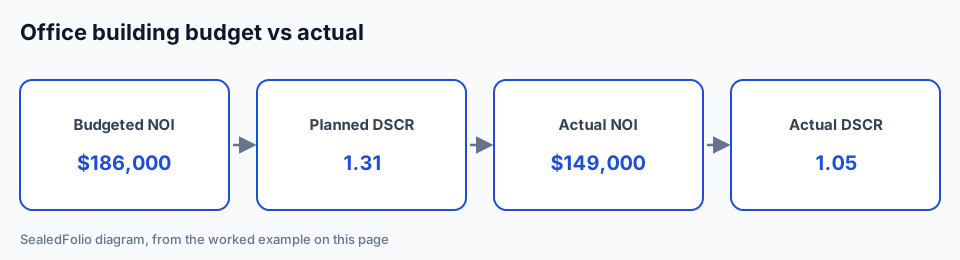
Diagram of the commercial property asset management example: budgeted NOI of 186,000 dollars and DSCR 1.31 fall to 149,000 dollars and DSCR 1.05 after higher expenses
Office building budget vs actual. Diagram by SealedFolio.
  1. Budget. The owner budgets $310,000 of income and $124,000 of operating expenses, for NOI of $186,000. Annual loan payments are $142,000, so the planned DSCR is 1.31 against a 1.25 covenant.
  2. Actual. A $28,000 property tax increase and a $9,000 jump in insurance push expenses to $161,000. NOI drops to $149,000.
  3. Result. DSCR falls to 1.05, below the covenant. The owner sees it in the budget variance by midyear instead of from the lender after year-end, appeals the assessment and shops the insurance renewal.

None of this needs an institutional platform. It needs the expenses categorized as they happen and a budget to compare them against. Test a covenant quickly with the cap rate calculator and cash flow calculator.

Institutional platforms vs owner software

CRE asset management platforms are built for sponsors, funds and REITs. They consolidate data from several property managers, model acquisitions, run distribution waterfalls and publish investor reports. They are sold on annual contracts with implementation projects, and they assume someone else keeps the property books.

An owner who self-manages, or who has one property manager, is in the opposite position: the books are the source data, and the asset view should come from the same place. That is the gap desktop rental software fills.

What SealedFolio does for asset management

Budgets, CapEx, scenarios and the SREO are on the Portfolio plan. SealedFolio has no investor portal, waterfalls or multi-manager data feeds. For the rest of the commercial setup, see commercial real estate software without the 50-unit minimum and the real estate investor page.

Asset-level numbers from your own books

SealedFolio Pro is $19 a month or $179 a year for up to 3 properties. Portfolio is $39 a month or $297 a year for unlimited properties. Both come with a 30-day money-back guarantee.

See SealedFolio pricing

Commercial property asset management software: frequently asked questions

What is the difference between property management and asset management?

Property management runs the building day to day: tenants, rent, repairs. Asset management looks at the building as an investment: NOI against budget, debt coverage, capital projects, value and whether to hold, refinance or sell.

What does commercial real estate asset management software do?

It rolls property-level income, expenses, debt and capital spending into investment metrics such as NOI, DSCR, LTV and budget variance, and it projects how those change under different assumptions. Institutional platforms add fund reporting, waterfalls and investor portals.

Is there asset management software for a small commercial portfolio?

Most CRE asset management platforms are sold to funds and operators with dozens of assets and an analyst team. A small owner with a few buildings needs the core metrics, budgets, CapEx tracking and a schedule of real estate owned, which desktop rental software such as SealedFolio covers.

Does SealedFolio include investor reporting or waterfalls?

No. SealedFolio is for owners managing their own properties. It has no investor portal, capital account tracking or distribution waterfall.